Let’s be completely honest about modern tourism: we are traveling more but experiencing less. We have turned travel into a high-speed checklist. We fly into a historic city, rush through a crowded landmark to get the perfect photo for our feed, grab a generic meal next to a tourist trap, and move on to the next destination. We return home from our vacations feeling more exhausted than when we left, with a camera roll full of identical images but very few actual memories.
But a massive shift is happening. The definitive travel movement of 2026 isn’t about counting countries or collecting passport stamps; it’s about The Travel Reset. Travelers are intentionally slowing down, rejecting chaotic itineraries, and choosing Slow Travel and Micro-Adventures. The focus has permanently shifted from merely ‘seeing’ a place to truly understanding its rhythm, its culture, and its people.
If you are ready to transform your next trip from a stressful commute into a deeply enriching human experience, here is your unfiltered guide to navigating the new era of mindful exploration.
1. The Power of Slow Travel: Why One City for Two Weeks Beats Five Cities in Ten Days
The biggest mistake modern travelers make is trying to see an entire continent in a single week. This frantic pace keeps you on the surface of a culture. Slow Travel is the deliberate decision to anchor yourself in one location long enough to let the tourist veneer fade away.
When you stay in a neighborhood for an extended period, your relationship with the destination changes completely. You stop looking at a map and start looking at the environment.
- The Daily Rhythm: You find a local café where the barista recognizes you by the third morning. You discover the quiet backstreets that don’t show up on viral travel blogs.
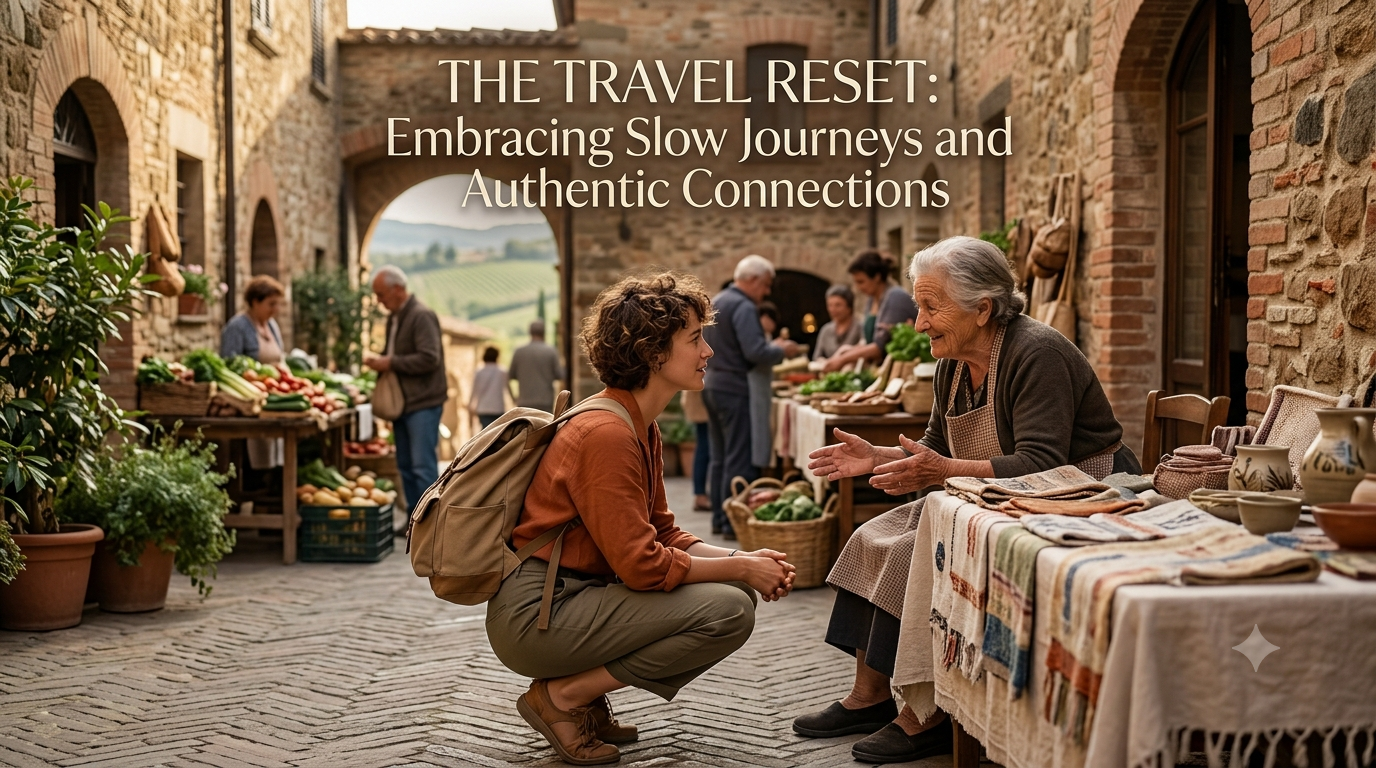
- The Deep Connection: As captured in our feature banner (image_10.png), Slow Travel allows you to engage authentically with the community—spending an afternoon talking to a local artisan, learning about their craft, and understanding the history of the neighborhood from the people who actually live there.
- The Sustainability Bonus: By reducing the number of internal flights, trains, and rushed taxis, you drastically lower your carbon footprint and ensure your travel money directly supports small, independent local businesses rather than massive corporate hotel chains.
2. Micro-Adventures: Finding Wild Spaces in Your Own Backyard
There is a toxic misconception that an adventure requires an expensive twelve-hour flight and a massive budget. This belief keeps us trapped in our daily routines, waiting for that one big trip at the end of the year. The rise of “Micro-Adventures” has completely shattered this mindset.
A Micro-Adventure is an exploration that is short, perspective-shifting, cheap, and local. It’s about realizing that adventure isn’t a geographical location—it’s a state of mind.
- The 5-to-9 Concept: You don’t need to wait for the weekend. A micro-adventure can happen between 5:00 PM when you leave your desk and 9:00 AM the next morning. It could be taking a train to a nearby ridge line you’ve never explored, camping under the stars, waking up with the sunrise, and heading straight back to work.
- Re-mapping Your Region: It forces you to look at your home territory with fresh eyes. Exploring local state parks, kayaking down a nearby river, or cycling through a historical route in your own province creates the same mental reset as an exotic destination, without the airport stress.
An Unfiltered Truth: The thrill of travel comes from uncertainty and novelty. You don’t need a passport to experience novelty; you just need to break your predictable daily patterns and step off the paved path.
3. Cultural Immersion over Consumerism: Learning the Story of a Place
The old model of travel was consumption-based—consuming food, consuming sights, consuming souvenirs. The modern traveler is focused on contribution and learning. True luxury in travel is no longer defined by the thread count of your hotel sheets, but by the depth of your immersion.
- Skill-Based Journeys: Instead of just walking through a historic district, travelers are enrolling in localized workshops. This means spending a week learning traditional culinary techniques from a home chef, understanding ancient pottery methods, or participating in localized wildlife conservation efforts.
- Language and Context: Even learning fifty basic phrases of the local dialect changes how you are received by a community. It shows respect. When you approach a new culture as a student rather than a consumer, the locals open up, and you get access to experiences that money simply cannot buy.
4. Embracing the Unplanned: The Art of Getting Lost
The enemy of authentic travel is the over-optimized itinerary. When every single hour of your day is pre-booked on an app—from your morning museum ticket to your 9:00 PM dinner reservation—you leave absolutely no room for magic.
The most memorable travel experiences are almost always the accidental ones: the wrong turn that led to an empty beach, the sudden rainstorm that forced you to take shelter in a lively local tavern, or the random conversation with a stranger that turned into a lifelong friendship.
- The White-Space Rule: Dedicate at least 40% of your travel itinerary to absolute nothingness. No plans, no bookings, no targets.
- The Intuitive Wander: Leave your phone in your pocket, pick a direction, and walk. Follow your senses—the smell of a bakery, the sound of music from a courtyard, or an interesting architectural archway. Let the destination reveal itself to you naturally.
The Reality Check (Conclusion)
The underlying truth of The Travel Reset—whether you are slowing down in a European town square (as beautifully captured in image_10.png), exploring a local forest on a Tuesday night, or learning a centuries-old craft—is that travel is an internal transformation.
You don’t need to go to the ends of the earth to find yourself. You just need to change the velocity at which you move through the world. When you stop chasing the highlights and start embracing the quiet, authentic corners, travel ceases to be an escape from your life and becomes a profound extension of it.
How are you planning your next journey? Are you ready to ditch the hectic multi-city itinerary for a slower pace, or are you looking for a micro-adventure right in your own backyard? Let’s talk about it in the comments below!