The technology narrative is shifting. For the better part of a decade, the conversation around Artificial Intelligence was dominated by fear and extreme efficiency metrics. We were promised (or threatened with) complete automation: AI systems that would replace diagnostic doctors, autonomous trucks that would make drivers obsolete, and software that would write all our code.
The reality of 2026, however, is far more nuanced, complex, and ultimately, optimistic. We are moving beyond the era of bare automation and entering the age of Collaborative Intelligence. This movement prioritizes Human-Centric AI—the deliberate design of systems built not to replace human decision-making, but to augment, protect, and empower it. The technological innovations that define this year are those that merge the processing scale of machine learning with the nuanced, ethical, and creative reasoning of human consciousness.
Here is an unfiltered look at the technological landscape and how this partnership is redefining innovation in three critical arenas.
1. Collaborative Medicine: The Diagnostic Symbiosis
Nowhere is the failure of full automation more evident than in healthcare. AI systems, while brilliant at identifying patterns in immense datasets (like scanning thousands of MRIs for anomalies), utterly fail when faced with a patient’s emotional context, their lifestyle nuances, or ethical complexity.
The human-centric approach in 2026 is creating a new model: Diagnostic Symbiosis.
- The Workflow: The AI processes vast amounts of real-time patient data—genetic markers, historical records, and current biometric streams. It identifies potential rare conditions with high mathematical probability.
- The Partnership: It presents these findings to a team of human doctors not as a conclusion, but as a hypothesis. The doctors then integrate these probability scores with the patient’s psychological state, social determinants of health, and personal values to co-create a treatment plan.
- The Impact: Doctors spend less time filtering data and more time performing care. AI mitigates diagnostic error by finding the needle in the haystack, while the human expert ensures the outcome is compassionate and ethically sound.
2. Generative Innovation: When AI Becomes the Ultimate Creative Catalyst
In the creative industries, the narrative was once: “AI is stealing jobs.” Today, the story is about Generative Integration. The technology that defines 2026 isn’t the kind that outputs generic art from a five-word prompt; it’s Expert Collaborative Models.
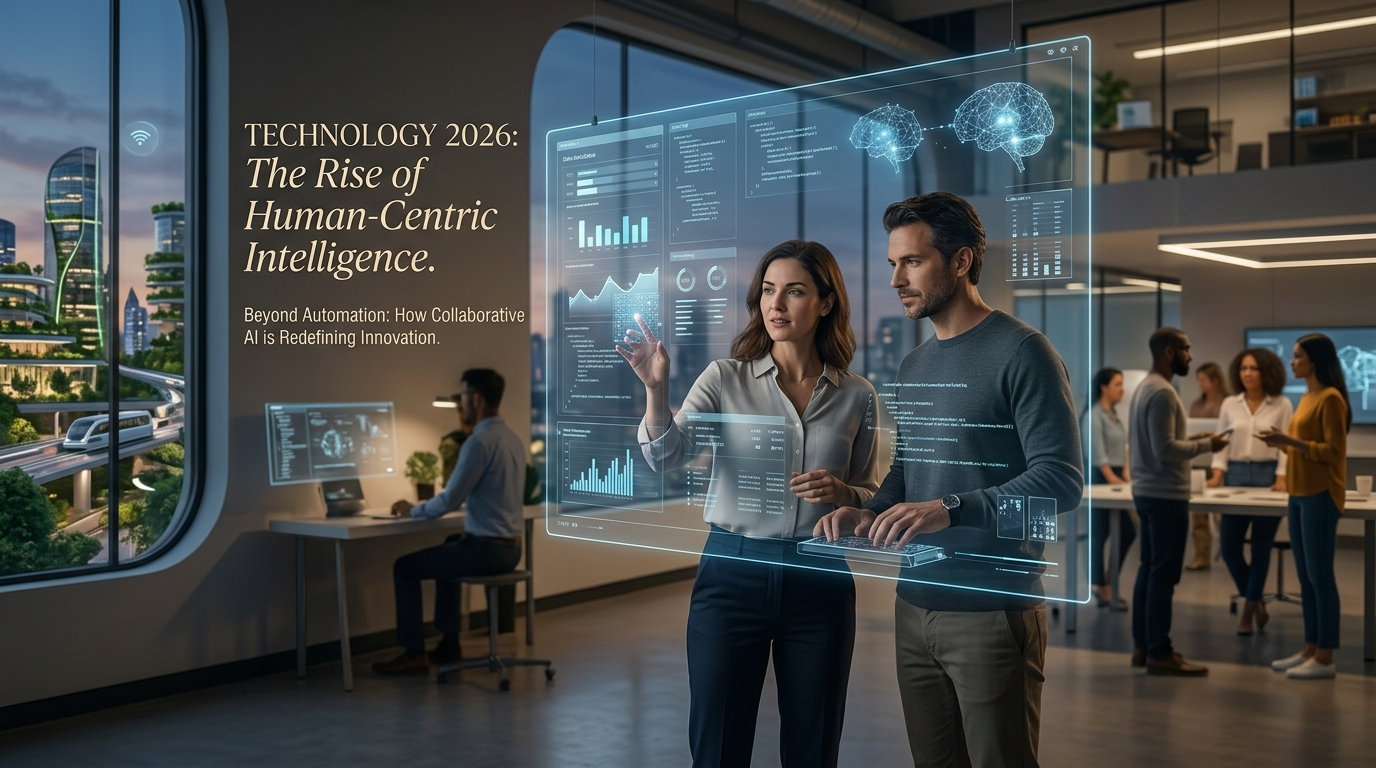
Creative professionals are utilizing sophisticated AI partners as deeply specialized assistants, not replacements. In visual design (like constructing our feature banner, image_8.png), an AI is used to simulate thousands of dynamic lighting scenarios and atmospheric conditions across a virtual landscape in minutes. The human creative director then selects the exact emotional texture that fits the narrative and refines the composition.
- The Shift: We are moving from ‘text-to-image’ to ‘concept-to-execution.’ Architects use AI to simulate structural integrity and environmental impact of complex sustainable designs. Software developers are paired with specialized AI coding partners that handle repetitive boilerplate code and debug errors in real-time, allowing the developer to focus on system architecture and user experience.
- The Result: A significant reduction in production friction. The barrier between a complex idea and its physical realization is dramatically lowered. True creative control remains where it belongs: with the human visionary.
3. Integrated Urbanism: Building Ethical, Secure Smart Cities
The previous vision of a smart city was a centralized, omniscient operating system that monitored every intersection. This failed because it prioritized efficiency over privacy and security. The human-centric alternative emerging in 2026 is Integrated Urbanism.
This model uses decentralized AI to optimize infrastructure (as visually conceptualized in the background of image_8.png) without sacrificing individual autonomy.
- Decentralized Intelligence: Traffic flow isn’t managed by one supercomputer, but by dozens of local, privacy-preserving AI nodes that communicate anonymously. They optimize energy grids and water distribution dynamically, responding to usage patterns while ensuring that raw data is never centrally stored.
- Proactive Ethics: The key technological shift is the deployment of Algorithmic Accountability Frameworks. Before any optimization AI is implemented in a public setting, it must pass rigorous testing against bias and transparency standards co-designed by technologists, ethicists, and community leaders. The technology serves the community, and the community has the right to understand why a dynamic optimization decision was made.
The Unfiltered Conclusion
The technological revolution of 2026 isn’t about the fastest processor or the largest language model. It is about Integration, Partnership, and Sovereignty. The innovations that are truly defining this era—whether in medicine, creativity, or urban design (vibrantly visualized in image_8.png)—are those that have been deliberately anchored in human values.
When we strip away the hype, we are left with a powerful new paradigm: Technology is no longer the omnipotent creator of our future; it is the most sophisticated, intelligent, and flexible collaborative tool that humanity has ever possessed.
Where do you believe Human-Centric Intelligence will have the most profound impact? Are you excited about Collaborative Medicine, or is Generative Innovation redefining how you work? Let’s open up the discussion below!